


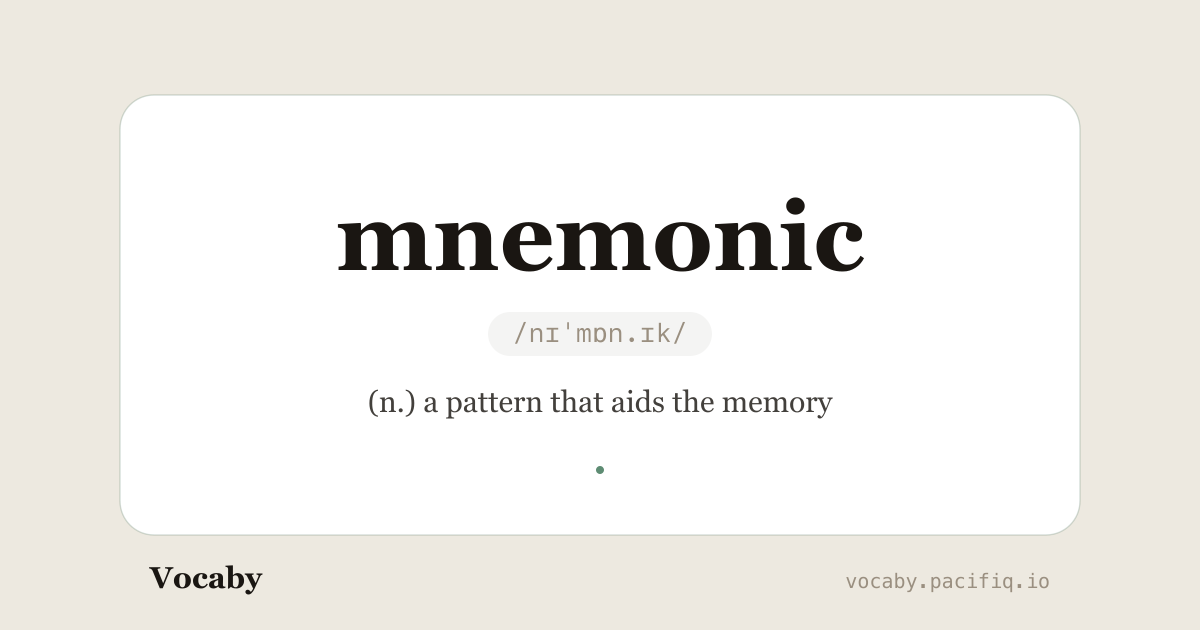
Active recall is the method of pulling a word out of memory instead of rereading it. You see a word, try to remember its meaning and pronunciation, and only then check. Decades of research show this makes words stick far better than reviewing them, which is why active recall is the single most effective thing you can do to really learn vocabulary rather than just recognize it.
What active recall actually is
Most people study vocabulary by reviewing: they read down a word list, look over definitions, maybe highlight a few, and feel like they’ve done the work. Active recall flips that. Instead of putting information back in front of your eyes, you force your brain to pull it out. You look at a word, cover the meaning, and try to produce it yourself before you check.
That single moment, the effortful pause where you’re reaching for an answer, is where the learning happens. It’s the difference between looking at “ephemeral, lasting a very short time” for the tenth time and looking at just “ephemeral,” feeling the strain of trying to remember, and then confirming. The first feels smoother. The second is what truly builds memory.
Flashcards are the classic active-recall tool, but only if you use them right. A flashcard works because the front asks a question your brain has to answer. Flip it the instant you see it and you’ve turned it back into passive review. The retrieval, that little test, is the whole point.
The evidence: testing beats rereading
This isn’t a productivity fad. It’s one of the most reliably proven findings in the science of learning, and the numbers are striking.
In a classic 2008 study published in Science, Jeffrey Karpicke and Henry Roediger had students learn Swahili-English word pairs. One group kept testing themselves on the words; another kept restudying them. A week later, the self-testing group recalled about 80% of the pairs, while the restudy group managed only about 33%. Same words, same time, more than double the retention, from nothing but the act of retrieval.
A 2011 study by Karpicke and Blunt pushed further, finding that retrieval practice produced substantially more learning than rereading or even making elaborate concept maps, techniques that feel far more sophisticated. The pattern holds across dozens of studies and has a name: the testing effect, or the retrieval practice effect. Testing yourself doesn’t just measure what you know. It changes what you know.
Why retrieval works when rereading doesn’t
The reason is almost counterintuitive: the effort is the feature, not a cost. When retrieving a word is a little hard, your brain treats that struggle as a signal that this memory matters and strengthens the path back to it. Cognitive scientists call this a “desirable difficulty.” Every time you successfully haul a word up from memory, you make it easier to find next time.
Rereading skips that entirely. It feels great, because recognizing a word you’re looking at is effortless, and that fluency fools you into thinking you know it. But recognition and recall are different skills. You can nod along to “ubiquitous, present everywhere” on a list and still freeze when the word is what you need to produce in a sentence. Active recall trains the skill you actually want, which is getting the word out when only its meaning, or only the word itself, is in front of you.
Even a failed guess helps
Here’s the part that takes the pressure off: you don’t have to succeed for active recall to work. Trying to remember a word and coming up blank, then seeing the answer, still teaches you more than never trying at all. The effort of searching primes your brain to grab onto the correct answer when it appears, as long as you get that feedback right away.
This matters because fear of getting it wrong is exactly what pushes people back toward safe, passive rereading. With active recall, a wrong guess isn’t a failure, it’s a productive attempt. So don’t skip a card just because you’re unsure of it. Take the guess, feel the gap where the word should be, and let the answer fill it. The words you struggle for and then recover tend to be the ones that stick hardest.
How to use active recall on vocabulary
The method is simple, but the details decide whether it works. Here’s how to do it well:
- Retrieve before you reveal. Look at the prompt, then pause and genuinely try to produce the answer. The pause is not wasted time; it is the exercise.
- Test both directions. Practice going from the word to its meaning, and from the meaning to the word. The second is harder and closer to what speaking demands.
- Say it out loud. Producing the word aloud, with its pronunciation, adds a second retrieval and locks in the sound, not just the spelling.
- Be honest about “almost.” If you only recognized the answer once you saw it, that’s a miss, not a hit. Mark it for another round.
- Keep each card to one word. Atomic prompts give you a clean retrieval. A card crammed with five facts tests none of them well.
- Mix it up. Don’t drill one theme to death in a single sitting. Shuffling different words and topics together, a habit researchers call interleaving, makes each retrieval a little harder and trains you to recall a word cold, the way you’ll actually need it.
The trap: “flashcards” that are secretly passive
Plenty of people use flashcards and still barely learn, because they’ve quietly slipped back into review. It helps to know what the passive version looks like next to the active one.
| Passive review (weak) | Active recall (strong) |
|---|---|
| Reading down a word list again | Covering the meaning and trying to recall it |
| Flipping the card the instant you see it | Pausing to retrieve before you flip |
| ”Oh yeah, that one” on seeing the answer | Producing the answer before it appears |
| Highlighting definitions | Saying the word and its meaning out loud |
| Studying the same list until it feels easy | Stopping while it’s still a little effortful |
The tell is effort. If your studying feels smooth and easy, you’re probably reviewing, not recalling. A bit of friction, the feeling of almost-but-not-quite, is the sign it’s working.
Active recall plus spaced repetition: the two pillars
Active recall answers the question of how to study. Spaced repetition answers when. Together they’re far stronger than either alone. Retrieval builds the memory; spacing your retrievals over days, so each word comes back right as you’re about to forget it, is what keeps it built.
The research here is just as clear. In a 2009 study, Nate Kornell found that students learning GRE vocabulary with spaced sessions recalled 31% more than those who crammed the same material in one block, with total study time held equal. The takeaway is practical: don’t drill a word ten times tonight and never again. Retrieve it a few times, then let a day or two pass before the next attempt, and let the gaps stretch as the word gets stronger. In practice that might look like meeting a word today, again tomorrow, then a few days later, then a week, then a month, each encounter a retrieval rather than a reread. You don’t have to plan those intervals yourself, which is the whole reason spacing software exists, but the shape is worth picturing: close together at first, then further and further apart as the word settles in. We unpack the timing side of this in spaced repetition explained, and it fits into the bigger picture of building vocabulary fast.
How Vocaby is built around active recall
Everything above describes a specific kind of tool: one that shows you a prompt, makes you retrieve before it reveals, and schedules those retrievals over time. That’s exactly the loop Vocaby is built on. Each card shows the word first, on its own, so you meet it as a genuine question and have to reach for the meaning before you swipe to check. That swipe is a retrieval, not a reread. And because the word stands alone, there’s no definition sitting right there to let you off the hook, so the moment of trying is unavoidable, which is exactly the point.
When the answer appears, it comes with the pieces that strengthen the memory: the pronunciation and IPA so you can say the word aloud and add that second retrieval, a plain-language definition, and a real example sentence that shows the word in use. An FSRS spaced-repetition schedule then brings each word back right before you’d forget it, turning single retrievals into lasting memory, and the swipe-to-learn flow keeps the whole thing light enough to do daily. You can also browse the full word library of more than 29,000 words, each one ready to be met as a prompt rather than a paragraph to skim.
The bottom line
If you take one idea from all of this, make it this: don’t reread words, retrieve them. The struggle of pulling a word out of memory, the exact thing that makes rereading feel easier, is what makes recall work. Test yourself before you check, say the word out loud, be honest about near-misses, and space your reviews over days. Do that, and the words stop slipping away, because you’re finally practicing the one skill that keeps them: getting them back.
Download Vocaby on the App StoreFrequently asked questions
- What is active recall?
- Active recall is the practice of pulling information out of your memory instead of passively rereading it. When you see a word, cover the meaning, and try to remember it before checking, you're using active recall. Each attempt to retrieve a word strengthens the memory of it, which is why it works so much better than review.
- Is active recall really better than rereading vocabulary?
- Yes, and by a wide margin. In a well-known 2008 study, students who repeatedly tested themselves on foreign vocabulary recalled about 80% of the words a week later, versus about 33% for students who only restudied them. Rereading feels productive because it's easy, but ease is exactly why it doesn't build durable memory.
- How do I use active recall with flashcards?
- Look at the prompt side, then pause and genuinely try to produce the answer from memory before you flip the card. Say it out loud if you can. Be honest about whether you actually knew it or just recognized it once you saw it. Then space your reviews over days instead of cramming, so each card comes back just as you're about to forget it.
Keep reading
Translations or English-Only Definitions? What Research Says
Everyone tells you to stop translating and learn words in English. The studies mostly say the opposite, at least for getting a word into memory. Here's what the evidence actually shows and how to use both without picking up bad habits.
Anki vs Vocaby: Which Is Better for Building Vocabulary?
A fair, head-to-head look at Anki vs Vocaby for building English vocabulary. Anki gives you total flexibility and your own cards; Vocaby gives you 29,000+ ready words with pronunciation, examples, and spaced repetition built in. Here is how to choose.
Spaced Repetition: How to Never Forget a Word
Spaced repetition schedules your reviews at the exact moment you're about to forget, so words stick with far less effort. Here's the science behind the forgetting curve, active recall, and the FSRS algorithm Vocaby uses to time every card.