


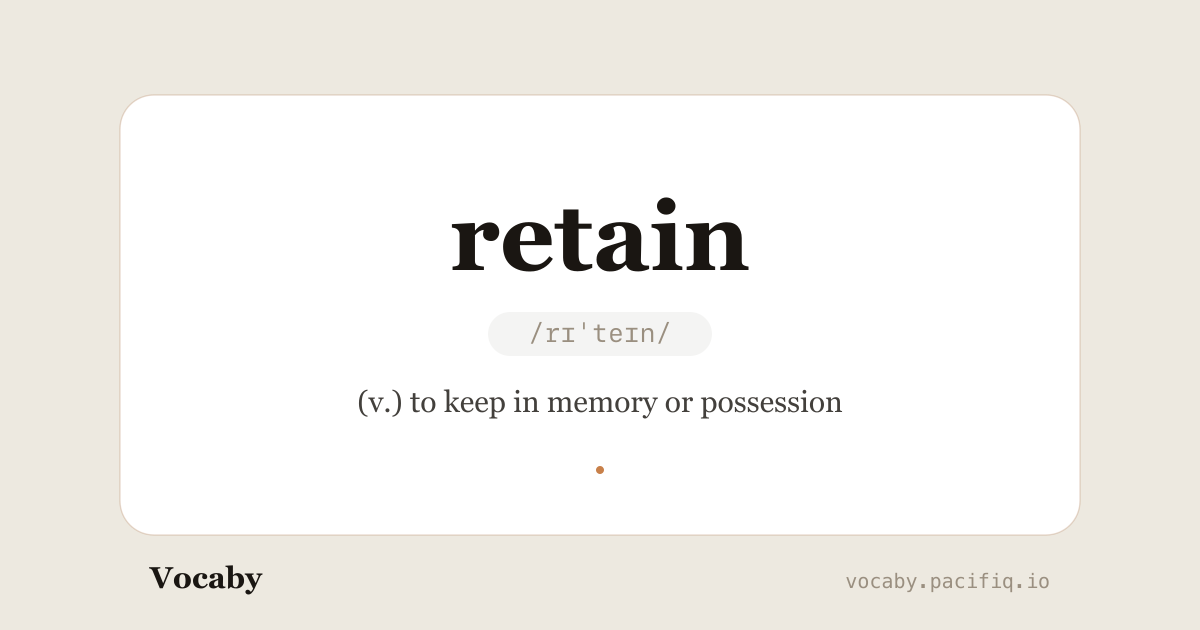
GRE vocabulary isn’t about memorizing definitions. The GRE tests words in context, through Text Completion and Sentence Equivalence, so what matters is knowing a word’s precise meaning and how it’s used, not just its dictionary gloss. The best way to learn it is in real sentences, spaced over time, starting with the high-frequency words that show up most.
Why GRE vocabulary is different
If you studied for the SAT, or learned English vocabulary from wordlists, the GRE asks for something more demanding. It isn’t testing whether you can attach a definition to a word. It’s testing whether you understand a word well enough to see how it functions inside a sentence you’ve never read before.
That shows up in the two vocabulary-driven question types. Text Completion gives you a sentence with one to three blanks and asks you to choose the words that make it coherent. Sentence Equivalence gives you one blank and six choices, and asks for the two words that produce sentences with the same meaning. In both, the answer doesn’t hinge on a bare definition. It hinges on how the word behaves in that specific context.
A quick illustration. Take a sentence like “Despite her _____ manner, the negotiator turned out to be surprisingly warm once talks began.” The blank wants something like “cold” or “aloof,” and once you’ve predicted that, you scan the choices for the word that fits, maybe frosty or brusque. Notice what you did: you reasoned from the sentence’s logic first, then matched a word to it. That is the GRE’s whole game, and it’s why a word learned only as a definition leaves you guessing at the exact moment you need it.
This is why “I know that word” can quietly betray you on the GRE. You might recognize pragmatic on a flashcard and still miss it in a sentence, because the test is checking a deeper kind of knowing. The good news is that this deeper knowing is learnable, and it changes how you should study from day one.
Definitions aren’t enough: you need nuance
Here’s the shift that trips people up. On the GRE, precision matters more than breadth. Knowing five hundred words with real depth will outscore recognizing three thousand words vaguely, because the test is built to punish the vague.
Sentence Equivalence makes this concrete. Picture an item where the blank clearly needs “praise.” Among the six choices you might find laud and extol, which both fit, alongside lampoon and deride, which mean the opposite, plus a near-miss or two. The two correct answers are the synonym pair that both mean praise, and spotting them is a nuance skill, not a definition-recall one. A word that’s almost right is wrong, and there’s no partial credit: every blank must be correct to earn the point. That design rewards students who know not just what a word means, but exactly when to use it instead of its cousins.
So the goal isn’t a longer list. It’s a sturdier grasp of each word, the kind that tells you laconic and taciturn both mean sparing with words but carry different flavors. Laconic leans toward pithy and deliberate; taciturn toward habitually silent or reserved. On a flashcard they look interchangeable; in a sentence they aren’t. That depth only comes from meeting words in real contexts, not from a definition column.
Focus on the high-frequency words first
The GRE could, in principle, draw on an enormous vocabulary. In practice, a much smaller set of words appears again and again, and that’s where your effort belongs. Prep programs converge on a core of a few hundred high-frequency GRE words for exactly this reason: they give you the most test coverage per word learned.
That mirrors how vocabulary works in general, where a modest set of words does most of the heavy lifting: the frequent words earn their place by simply showing up more often. For the GRE specifically, it means you should resist the urge to memorize giant obscure lists early. Lock down the frequent words first, learn them deeply, and only then widen the net. A student who truly owns the core list is in far better shape than one who has skimmed a 4,000-word deck once.
There’s a motivational reason too. A giant list of alien words is where study plans go to die: you meet dozens of words you’ve never seen, remember almost none of them, and quietly conclude you’re bad at vocabulary. Starting from the high-frequency core gives you early, real wins, words you will genuinely see on the test, and that momentum is what keeps you studying long enough for the rarer words to accumulate. Momentum is a strategy, not just a mood.
A sample of the GRE’s favorite words
To make it concrete, here are ten words in the GRE’s characteristic register, with their pronunciation and meaning. Notice that several are genuinely hard to say, which is part of why hearing them matters.
| Word | IPA | Meaning |
|---|---|---|
| abstruse | /æbˈstruːs/ | hard to understand; obscure |
| laconic | /ləˈkɒnɪk/ | using very few words; terse |
| sycophant | /ˈsɪkəfənt/ | a self-serving flatterer |
| ephemeral | /ɪˈfɛmərəl/ | lasting a very short time |
| garrulous | /ˈɡærələs/ | excessively talkative |
| capricious | /kəˈprɪʃəs/ | given to sudden changes of mood |
| ubiquitous | /juːˈbɪkwɪtəs/ | present everywhere |
| prosaic | /prəˈzeɪɪk/ | dull and ordinary |
| assuage | /əˈsweɪdʒ/ | to make an unpleasant feeling less intense |
| capacious | /kəˈpeɪʃəs/ | roomy; able to hold a lot |
Read that list and a pattern jumps out: these are not everyday words, and their spellings give few clues to their sound. Sycophant and assuage are landmines to pronounce, which matters more than it seems, because a word you can’t say is a word your memory struggles to hold.
Use word roots to decode the obscure ones
There’s a reason GRE words feel so ornate: the fancier and more obscure a word is, the more likely it comes from Greek or Latin. That’s not just trivia; it’s a shortcut. If you know a handful of roots, you can often reason your way to a word’s meaning even when you’ve never formally learned it.
Benevolent, malevolent, and voluble all carry Latin pieces you can decode. Loquacious and garrulous both circle the idea of talking. The root loqu means “speak,” which also surfaces in eloquent and circumlocution; bene means “good,” mal means “bad,” and phil means “loving,” as in bibliophile. A dozen roots like these can unlock scores of GRE words at once. Building a small stock of high-value roots turns a wall of strange words into a set of recognizable parts, which is why we treat roots as a core strategy in learning vocabulary with word roots. For the GRE, roots do double duty: they help you learn the words faster and guess intelligently on the ones you don’t know.
The right way to study GRE vocabulary
Put the pieces together and a clear method emerges. It’s less about heroic cramming than steady, well-shaped practice:
- Learn words in sentences, not columns. Since the test checks usage, always meet a new word in a real sentence, so you store how it behaves, not just what it means.
- Group near-synonyms. Study laconic, terse, and succinct together to feel their overlaps and edges. This is exactly the skill Sentence Equivalence rewards.
- Start with high-frequency words. Master the core few hundred before chasing rare ones.
- Add a few words a day, and review the old ones. A steady pace of ten to twenty new words, with regular review, covers the core list over a couple of months without burning out.
- Hear each word and learn its roots. Pronunciation locks a word into memory, and roots make the obscure ones decodable.
The quiet engine under all of this is spaced repetition. GRE vocabulary is a volume problem: too many words to hold by rereading a list. Spacing your reviews, so each word returns just before you’d forget it, is what makes hundreds of words stick, a mechanism we explain in spaced repetition explained.
How Vocaby fits GRE prep
Everything above points to the same shape of tool: one that gives you words in context, with sound, and resurfaces them on a schedule. Vocaby is built to be exactly that. Every word in its library of more than 29,000 words carries audio and IPA, so a tongue-twister like sycophant arrives with its pronunciation attached, and an FSRS spaced-repetition schedule brings each word back right before it would slip.
A swipe-to-learn flow keeps daily practice light instead of list-shaped, which is what makes a ten-to-twenty-words-a-day habit sustainable across two months of prep. Curated decks let you concentrate on the vocabulary that matters for your goal, and you can browse the whole word library by sound and meaning to see how words connect. None of this replaces doing practice questions, but it solves the part practice questions can’t: holding a few hundred precise words in memory long enough for test day.
GRE vocabulary rewards depth over breadth, and depth is a matter of how you study, not how hard. Meet the high-frequency words in real sentences, hear them, decode them with roots, and review them on a schedule, and the words that once looked like a wall become a set you actually own, ready when the sentence in front of you needs exactly the right one.
Download Vocaby on the App StoreFrequently asked questions
- How many words do I need to learn for the GRE?
- There's no fixed number, but most prep centers on a core of a few hundred high-frequency words that recur on the test, then expands outward. Because the GRE rewards precision, knowing several hundred words well beats vaguely recognizing thousands. Consistent spaced review is what lets you hold that many at once.
- Does the GRE test vocabulary by definition?
- No. The modern GRE tests words in context through Text Completion and Sentence Equivalence, not isolated definitions or antonyms. The right answer depends on how a word fits the sentence, so you need to know a word's usage and nuance, not just a one-line dictionary meaning you memorized on a flashcard.
- What is the best way to memorize GRE words?
- Learn each word inside a real sentence so you grasp how it's used, group similar words together to feel their nuance, and review on a spaced schedule so they stick. Hearing the word and learning its roots helps too, since many GRE words are obscure and share Greek or Latin origins.
Keep reading
Duolingo English Test Vocabulary: What to Study and How
The Duolingo English Test is adaptive, so a broad vocabulary directly raises your score. Several question types are pure vocabulary. Here's what kind of words to study and how to actually make them stick.
IELTS Vocabulary: How to Reach Band 7+
Band 7 on Lexical Resource isn't about memorizing rare words. It rewards a wide range of vocabulary used accurately, with natural collocations and precise meaning. This guide breaks down the descriptor and gives you topic vocabulary that actually scores.
SAT Vocabulary: 40 High-Frequency Words to Master
A study-ready list of 40 high-frequency SAT vocabulary words with parts of speech, clear definitions, and example sentences. Plus a simple method for learning SAT words in context the way the Digital SAT actually tests them.