Blog
Practical guides on building vocabulary, studying smarter, and remembering more.
Every reading test hands you two vocabularies. One is in the passage and you study it. The other is in the question, it is much smaller, and it decides which of four true-sounding answers is the one they will mark correct.
The usual advice is to turn subtitles off and suffer through it. The research says captions help, that the size of the help is known, and that the setting people argue about matters less than the order you use them in.
Every flashcard runs in a direction. Word to meaning trains reading; meaning to word trains speaking. The research says they are not interchangeable, and the one that helps you most changes as your level rises.
Nice once meant foolish. Awful once meant awe-inspiring. Meat was any food at all. Here is how English words drift, the patterns the drift follows, and why a moved meaning is harder on learners than a word you have never seen.
IELTS Listening gives one mark per question and nothing for a near miss, so a misspelled answer scores the same as a blank. Most of those misses start in the ear, not the memory, and they cluster into a handful of predictable word groups.
Learners who only listened to a story could write the meaning of 2 percent of its new words right afterward, and none three months later. Here is what the research says about listening versus reading, the one mode that beats both, and a routine that makes audio actually count.
You know the word, you can define it, and it will not come out. Memory research has a clear account of why this happens more often in a second language, and it points to a study habit most learners skip.
A murder of crows and a parliament of owls come from a 1486 hunting manual that was half a joke when it was written. About a dozen animal group words are still doing real work in English, and those are the ones worth learning.
Words in Context is not a test of whether you know hard words. It hands you four ordinary academic words and asks which one the sentence will accept, which is why you can recognize all four and still choose wrong.
The 8-to-12 figure gets quoted as if it were settled. It comes from studies of incidental reading, the individual studies range from 6 to more than 20, and the largest meta-analysis found repetition is only a medium predictor of what sticks.
English keeps hundreds of word pairs locked into one order by nothing but habit. Salt and pepper. Back and forth. Safe and sound. Reversing one is not a grammar mistake, which is exactly why nobody ever corrects it for you.
Lead and lead. Tear and tear. Wound and wound. English keeps hundreds of words that share a spelling but not a pronunciation, and silent reading is very good at hiding them from you. Here is where they cluster and how to stop mispronouncing the ones you already know.
You caught a word in a podcast, you know roughly how it sounds, and you cannot find it because you cannot spell it. Dictionaries are sorted by the one part of a spoken word you are least likely to have heard correctly. Here is a method that works from the sound instead.
English keeps a short Old English word, a French one from after 1066, and a Latin one borrowed by scholars. Ask, question, interrogate. Here is where the three layers came from, how to tell them apart, and which one to actually use.
Some English words survive in exactly one expression and nowhere else. Kith, shrift, fro, bated. Here is where they came from, why a dictionary rarely helps, and how to learn a word that has no independent life.
When a word will not stick, the usual assumption is that something is wrong with your method or your memory. Often the word is simply more expensive than the ones around it, and the cost is measurable in advance.
Everyone has one: a word they used confidently for years with the wrong meaning. The research says those confident mistakes are the easiest ones to fix, which is not what most people expect, and there is one condition attached.
Frail and fragile are the same Latin word, borrowed twice, six hundred years apart. English is full of these pairs, and the two halves are almost never interchangeable.
The tidy answer is to mix everything, because interleaving beats blocking in most of the research. The honest answer has conditions attached, and two of them are likely to apply to you.
Every vocabulary list has a handful of words that refuse to stick no matter how many times they come back. The usual response is to review them harder. That is the one thing that reliably does not work, and the reason is in how the card was built.
Posh is not Port Out Starboard Home. Tip is not To Insure Promptness. The useful part is not the individual debunkings but the rule underneath them, which lets you judge the next one you hear without looking anything up.
Peruse, nonplussed, decimate, literally. For a handful of common words, educated native speakers hold opposite ideas about what they mean, and dictionaries record both. Here is how to decide what to do with them as a learner, which is a different question from who is right.
Accommodate, separate, occurrence, supersede. The words people misspell most are not a random set, and the double letters in particular are not arbitrary. Most of them come from a Latin prefix crashing into a root, which means the spelling is derivable rather than memorisable.
Informal, dated, literary, disparaging. Those little italic tags before the definition are the part that tells you whether you can actually use the word, and almost everyone reads straight past them to the meaning.
Sandwich, boycott, silhouette, draconian. Dozens of ordinary English words started out as a person, and most of them kept that person's reputation. That is the part the trivia lists leave out, and it is the part that decides whether you can use the word neutrally.
Every vocabulary list you have ever used groups words by meaning. Forty years of research says that is the one arrangement that makes them hardest to learn. Here is what actually happens, and what to do instead.
Sanction means to approve and to penalise. Cleave means to split and to cling. These are contronyms, and English makes them three completely different ways, one of which is just an accident of spelling.
You took a test, got a number, and now you want to know if it is true. It probably is, for a narrower definition of knowing a word than you had in mind. Three design choices explain the gap.
Most advice tells you to learn phrases instead of isolated words. That is one answer to a question that has two, and which one is right depends entirely on what is currently going wrong for you.
Nobody needs a native accent. But some pronunciation errors genuinely stop people understanding you, and others cost nothing at all. The useful skill is telling them apart instead of trying to fix everything.
English took words from French, Latin, Greek, German, Arabic and Japanese, and each source left fingerprints on the spelling. Once you can read those fingerprints, a lot of English pronunciation stops looking random.
The research on age and language learning says something more useful than yes or no. Adults are faster than children at the start, the age effect is real but narrower than the folklore suggests, and the thing that actually gets harder is not the part most people worry about.
Guessing unfamiliar words from context is the most recommended vocabulary strategy there is, and it comes with a condition almost nobody mentions. It only works once you already know nearly every other word on the page.
Shadowing is usually sold as accent training. The memory research points somewhere more useful, and there is one mistake that quietly cancels the whole benefit.
The January 2026 redesign changed how TOEFL tests vocabulary, not just which words it uses. One task now makes you type the missing letters, and a large share of those blanks are not academic words at all.
You lose less than you fear, and you lose it on a schedule. The research shows a steep drop for the first few years and then a long plateau, plus strong evidence that most 'forgotten' words are still in there waiting.
The research lands around eight to ten encounters, but that number hides the important part. What counts as learned changes the answer completely, and recognition turns out to be far cheaper than recall.
Adding an s covers most of English. The exceptions are small in number but they cluster in academic and professional writing, and several change how the word is pronounced. Here is the set worth learning and the disputes that are still unsettled.
Not the way the apps imply. You can't absorb new words overnight, but sleep is when the words you studied while awake actually stick. Here's what the research really found and how to use it.
A word you don't know isn't a word you use badly. It's a thought that never arrives. Here's what vocabulary size actually changes, why the limit is invisible from the inside, and where the famous quote about it goes too far.
Everyone tells you to stop translating and learn words in English. The studies mostly say the opposite, at least for getting a word into memory. Here's what the evidence actually shows and how to use both without picking up bad habits.
Every guide hands you a hundred linking words. Examiners penalise the writing that uses them all. Here's the shorter list that actually works, grouped by job, with the grammar traps that cost marks.
C1 Advanced doesn't reward knowing rare words. It rewards knowing ordinary words completely, including every form they take and the words they sit next to. Here's what that means for how you study.
Comprehensible input means language you can mostly understand, just slightly above your level. It's the most powerful engine for early progress, and it quietly runs out of fuel at intermediate. Here's what it does well and where it needs help.
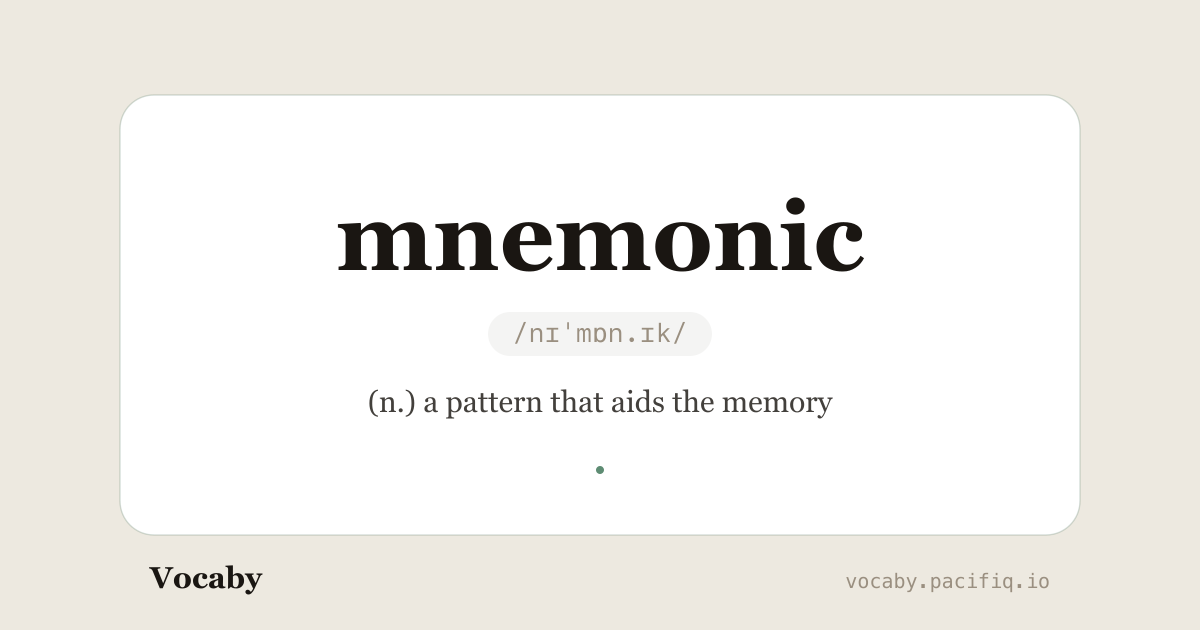
A mnemonic turns a hard word into a picture your memory refuses to drop. The keyword method, vivid imagery, and etymology all make new vocabulary stick faster, and pairing them with review and sound is what makes them last.
Describing a person needs more than 'nice' or 'mean.' The right adjective captures exactly what someone is like, and the same behavior can sound positive or negative depending on the word you pick. Here's a useful list, organized and explained.
Studying vocabulary for an exam isn't the same as building vocabulary in general. You have a date, a syllabus, and sections that test words in different ways. Here's how to study the right words, the right way, so they hold until test day.
Rapid early progress, then a wall: the intermediate plateau is when English seems to stop improving no matter how much you use it. It's normal, and it's mostly about vocabulary. Here's why it happens and how to break through.
Passive vocabulary is the words you recognize; active vocabulary is the words you can actually produce. The gap between them is why you can read a word fine but never reach for it when speaking. Here's how to close it.
Collocations are the word pairs English speakers expect to hear together, like 'make a decision' or 'heavy rain'. Knowing them is what separates correct English from natural English. Here's what they are, the ones worth learning, and how to make them stick.
The PTE Academic is computer-scored and integrated, so vocabulary shows up in almost every task rather than one section. Some questions are pure vocabulary and collocation. Here's what words to study and how to make them stick.
There's no single number, but the honest answer is clearer than it sounds. Reaching confident conversation takes most learners around 500 to 600 hours of study. How fast that is depends entirely on how much you do each day.
There's no magic number, but for most people 10 to 20 new words a day is the sustainable sweet spot. The real limit isn't how many you can learn, it's how many you can keep reviewing. Here's how to find your number.
Onomatopoeia are words that imitate the sound they describe, like buzz, splash, and crash. They make writing vivid and speech natural. Here's a list by category, why they're worth learning, and why you have to hear them, not just read them.
The Duolingo English Test is adaptive, so a broad vocabulary directly raises your score. Several question types are pure vocabulary. Here's what kind of words to study and how to actually make them stick.
You can read and follow English fine, but the words won't come out when you speak. That's the gap between passive and active vocabulary, and it's normal. Here's why it happens and how to close it.
Reading is how most people build a large vocabulary, by meeting words in real context. But exposure isn't the same as retention. Here's how to read for vocabulary, and how to keep the words you meet.
Silent letters are letters you write but never say, like the b in doubt or the k in knife. Here's why English has so many, the main patterns to recognize, and the reliable way to learn how these words actually sound.
The Academic Word List is 570 word families that appear across all academic writing and cover about 10% of any academic text. Here's what's on it, why it's the highest-value vocabulary to learn, and how to actually master it.
Translating in your head is the reason English feels slow. Here's why it happens, how to learn words as concepts instead of translations, and how to build the fast recall that lets you think in English.
Active recall is the single most effective way to learn vocabulary, and it's backed by decades of research. Here's what it is, why testing beats rereading, and how to actually use it on the words you keep forgetting.
Idioms are where 'just learn the word' breaks down. Here are common English idioms with clear meanings and examples, why they trip up learners, and the way to actually make them stick.
GRE vocabulary isn't about memorizing definitions. The test checks words in context, so what matters is precise meaning and usage. Here's how the GRE really tests vocabulary and the smartest way to learn it.
A small set of words does most of the work in English. The top 100 make up about half of everyday writing, and the first few thousand cover most of what you read and hear. Here is how word frequency works and how to use it to learn faster.
Word roots are the building blocks of thousands of English words. Learn one root like spect, meaning to look, and you unlock inspect, spectator, and perspective at once. Here is how roots, prefixes, and suffixes work, plus the highest-value ones to know.
Affect or effect? Their, there, or they're? English is full of word pairs that look or sound alike but mean different things. Here are the ones that trip people up most, with a simple trick to keep each one straight.
A phrasal verb is a verb plus a small word like up or off that changes its meaning, like give up or find out. Here is a practical list of the most common ones, with example sentences and a method that makes them stick.
A clear accent beats a perfect one. Improving English pronunciation means training the exact sounds you struggle with, learning to read IPA, and copying the rhythm of real speech. Here is a routine that works.
Colonel, mischievous, anemone: some English words look nothing like they sound. Here are the hardest ones to pronounce, with the IPA and the trick to finally saying each correctly.
You do not need to know all of English to be fluent. Research on vocabulary coverage shows a few thousand well-chosen words carry most conversations. Here is what the numbers actually say.
'Very tired' is weaker than 'exhausted.' Swapping 'very + adjective' for one precise word makes your writing sharper. Here is a reference table of stronger words, and how to actually learn them.
A fair, head-to-head look at Anki vs Vocaby for building English vocabulary. Anki gives you total flexibility and your own cards; Vocaby gives you 29,000+ ready words with pronunciation, examples, and spaced repetition built in. Here is how to choose.
A curated collection of the most beautiful English words, complete with accurate IPA pronunciation, definitions, and graceful example sentences. Discover words about feelings, nature, and the quiet passage of time.
A fair, balanced look at the best vocabulary apps in 2026, including Vocaby, Anki, Quizlet, Magoosh, WordUp, and Memrise. We compare spaced repetition, pronunciation, free tiers, and who each app actually suits.
A practical, encouraging guide to building English vocabulary for Korean speakers. Learn why rote 단어장 memorization fails, how to study words in context, master pronunciation, dodge Konglish traps, and make new words stick with spaced repetition.
A practical, evidence-aware guide to building your vocabulary fast. Learn the nine methods that stick, from reading widely and spaced repetition to learning word roots and using new words in real conversations.
Band 7 on Lexical Resource isn't about memorizing rare words. It rewards a wide range of vocabulary used accurately, with natural collocations and precise meaning. This guide breaks down the descriptor and gives you topic vocabulary that actually scores.
A study-ready list of 40 high-frequency SAT vocabulary words with parts of speech, clear definitions, and example sentences. Plus a simple method for learning SAT words in context the way the Digital SAT actually tests them.
Spaced repetition schedules your reviews at the exact moment you're about to forget, so words stick with far less effort. Here's the science behind the forgetting curve, active recall, and the FSRS algorithm Vocaby uses to time every card.